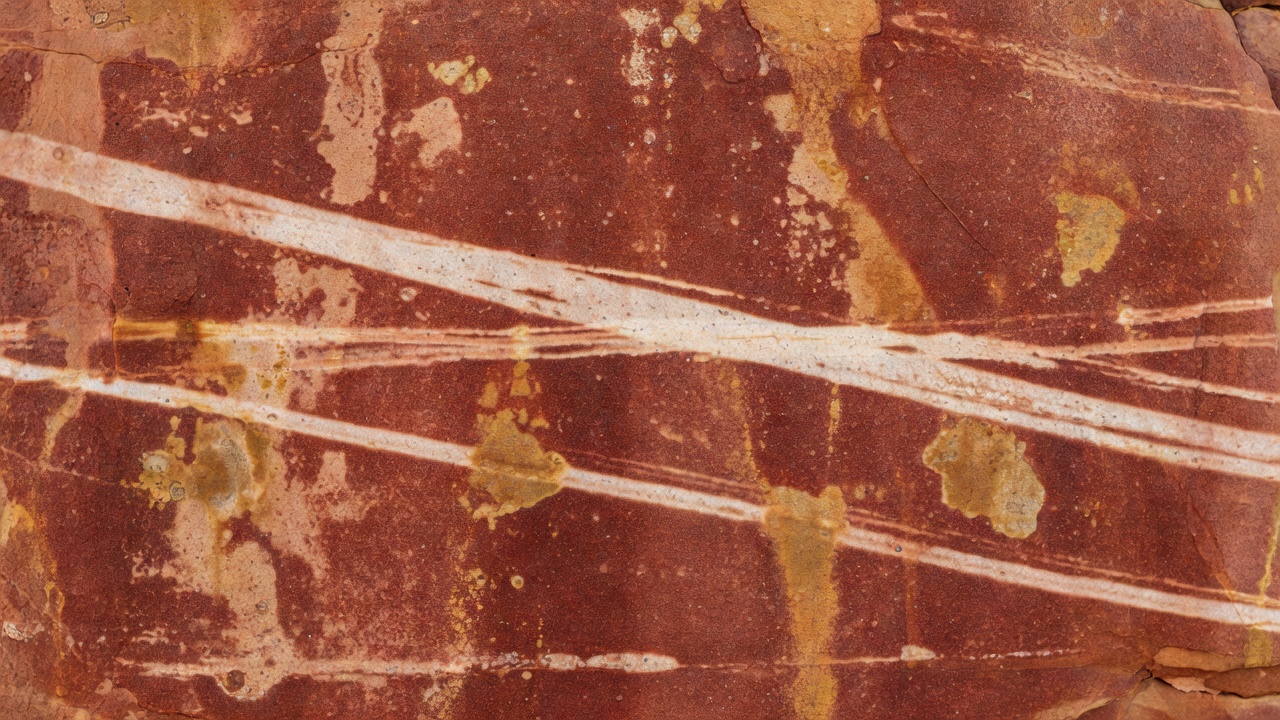
A small amount of iron, a large visual effect
Many red sandstones owe their color to iron-bearing minerals, particularly fine hematite coatings on sediment grains. Quartz grains themselves may be pale or nearly colorless. A thin pigment coating can therefore dominate the appearance of an entire cliff without making iron the main ingredient of the rock. “Red sandstone” describes a visible characteristic, not a complete mineral inventory.
Iron can be present in the original sediment and can also move during later chemical alteration. Conditions involving oxygen commonly favor ferric iron minerals associated with red and yellow-brown colors. The familiar comparison with rust is helpful, but natural rock staining has a more varied chemical history than the corrosion of a metal object. Avoid treating every warm-colored patch as the same mineral.
Compare color with the rock’s structure
Stand where you can safely follow a color boundary across the exposure. Does it remain parallel to bedding? Does it cut through inclined layers? Does it surround a fracture or form an irregular patch? These relationships can help distinguish sedimentary variation from later alteration, though they rarely settle the question on their own. Record the geometry before proposing a cause.
Cross-bedding is the preserved internal layering produced as dunes or other sedimentary bedforms migrate. It is not simply a set of mineral-color stripes. In the Navajo Sandstone of the Colorado Plateau, large cross-bed sets are important evidence of ancient windblown dunes. The formation’s red, orange and pale areas can also reflect later changes, so depositional structure and present color need to be considered separately.
Mineral-color comparison
| Visible appearance | Possible contributor | Important limit |
|---|---|---|
| Red to reddish brown | Fine hematite in coatings or cement | Lighting and grain properties change the apparent shade. |
| Yellow to yellow-brown | Goethite and other iron-bearing alteration products | Color alone cannot identify a mineral mixture. |
| Pale cream or white | Low pigment content or removal of iron staining | A pale zone is not automatically a separate formation. |
| Dark surface film | Desert varnish, biological growth or other coatings | Composition and origin vary; do not scrape the surface. |
Desert varnish is a thin coating commonly containing manganese and iron compounds along with clay minerals. Its development is complex and differs from the internal coloring of a sandstone bed. Dark surfaces may also include organisms or other deposits. Observe without touching, scratching or wetting rock, especially near cultural markings. Surface disturbance can damage features that have scientific or cultural significance.
What pale patches may reveal
Groundwater moving through pores and fractures can redistribute iron. Under suitable chemical conditions, iron may be dissolved and transported away, leaving a lighter zone; elsewhere, precipitation can concentrate iron in bands, spots or concretions. This broad explanation is useful, but an individual patch may have a more complicated history. Laboratory analysis and geological context are often needed to distinguish alternatives.
Concretions are localized masses of mineral cement within sediment or sedimentary rock. Some iron-rich examples are strikingly round, but roundness does not make them fossils, eggs or meteorites. In protected areas, leave them where they are. Their relationship to the surrounding rock is part of the evidence, and collecting may be prohibited even where an object appears loose.
Do not use red as a climate shortcut
Red beds occur in a range of geological settings. Their color can arise during deposition, soil formation, burial or later fluid movement. To reconstruct an ancient environment, geologists combine evidence such as grain size, sedimentary structures, fossils, mud cracks and regional relationships. A red cliff alone cannot prove that its sediment accumulated in a hot desert, nor that the area remained dry afterward.
For a practical comparison, examine photographs of the Navajo Sandstone in Zion and the Permian Coconino Sandstone at Grand Canyon with their official geological descriptions. Both can preserve evidence relevant to ancient dunes, yet their ages and subsequent histories differ. Similar structures are an invitation to compare evidence, not a reason to merge separate formations into one story.
Make color notes that travel well
Record whether the surface is dry, in direct sunlight or in open shade. A wet patch generally looks darker, and warm reflected light can change an otherwise pale wall. Photograph a broad context view and a close detail without increasing saturation to make a diagnosis. Describe the hue plainly and label mineral names as tentative unless a reliable local source or analysis supports them.